The Storming of the Fortress

Words hard as stone bombard the castle walls,
hurled with precision to break my defense,
all heedless of the wintry rain that falls.
A breach is opened in the outer fence.

The gate shivers beneath unflinching blows,
and soon the dauntless warrior gains the keep.
I hide myself, but all too well he knows
the passages that lead into the deep

and lightless chamber where my soul would stay
in silent shadows rather than surrender.
His footsteps near, and now the door gives way.
His grip is strong — but, oh, his voice is tender!

I give myself up; finally I see:
he frees me from myself, in spite of me.

~ Rebekah Choat


Word by Madeleine L’Engle

I, who live by words, am wordless when
I try my words in prayer. All language turns
to silence. Prayer will take my words and then
reveal their emptiness. The stilled voice learns
to hold its peace, to listen with the heart
to silence that is joy, is adoration.
The self is shattered, all words torn apart
in this strange patterned time of contemplation
that, in time, breaks time, breaks words, breaks me,
and then, in silence, leaves me healed and mended.
I leave, returned to language, for I see
through words, even when all words are ended.
I, who live by words, am wordless when
I turn me to the Word to pray.  Amen.

The Life of Words

image copyright Rebekah Choat

image copyright Rebekah Choat

A word is dead
When it is said,
Some say.

I say it just
Begins to live
That day.

~ Emily Dickinson

A word is dead when it is said, some say.

Dead things do not change (except to decay). There is nothing pulsing inside them. They do not grow or stretch or think. They are cold, stiff, unfeeling. They do not change direction. They do not respond. They are finished, over, chiseled in stone.

Some words, it seems, die quietly, of plain old age and disuse. Their passing, if we are even aware of it, doesn’t affect us much. They’re a little like the great aunts we might have met once at a family reunion when we were very young, the ones whose pictures look vaguely familiar when we flip through old albums. We may recognize them with a half-smile, murmur something about what interesting lives they must have had, and forget them once the page is turned. Widdershins, for example: she was a fine old character, but she only appeared once or twice on the periphery of my experience. And remember ugsome? Not really, but I heard an amusing story about her once. I can’t honestly say I miss them, or even notice their absence from day to day.

It’s harder to accept the loss of words that have been waylaid and maimed. You know the ones I mean. Queer. Retard. Gay. A dozen others now declining in similar fashion. Like beloved grandparents ravaged by Alzheimer’s Disease, their appearance hasn’t changed, but the meaning, the personality behind the face, is so altered as to be almost unrecognizable. The body is still here, but we mourn the death of the original spirit.

Then, sadly, there are words that meet violent ends – maybe sometimes as accidental casualties of simple carelessness, but sometimes through malice aforethought. Some say words in such a way that they fall, already lifeless, from their lips.

Who are these some, and what are the death sentences they pronounce? Absolute literalists: “That’s what the Bible says. Period.” Hopeless fatalists: “The doctor said it’s incurable.” Immovable traditionalists: “It’s sacrilegious to change the old way of saying things.” Smug pedagogues: “It means what I say it means. How dare you question my authority?” Harsh critics: “You’re never going to be any good.” Implacable parents: “Don’t ask again. That’s my final word on the matter.” To all of these, a word is dead when it is said.


I say it just begins to live that day.

Living things breathe. They are warm and fluid. They grow, they ripen. They move and change and interact with other living things. They feel and remember and dream. They have the power to engender more life.

I am awed by the innate power, the pulsing life of words. I believe that when we speak or write them, we give words birth. And like children, they fare forth and grow in ways we don’t always expect. It’s a risk, sending our words (and our kids) out into the wide world, among people who neither know nor care what pains we took to plan and prepare and present the fruits of our labors. We can’t be sure that they will be understood and appreciated for what we think they are; in fact, it’s more certain that they sometimes won’t be. And this is the frightening and freeing mystery.

“…our works never mean to others quite what we intended; because we
are re-combining elements made by Him and already containing His
meanings. Because of those divine meanings in our materials it is
impossible that we should ever know the whole meaning of our own
works, and the meaning we never intended may be the best and
truest one,” C.S. Lewis says in “Bluspels and Flalansferes.”

We do the best we can, as writers, as speakers, as parents. We struggle to make our ideas clear, to impart our values, to get everything just right. We invest ourselves, body, mind, and soul, in our offspring of flesh and blood, pitch and timbre, paper and ink. And then we let them go, trusting them to the Omnipotence, knowing they will go places and touch people we will never see, in ways we can’t anticipate. We understand, if only dimly, that although we gave them birth, the breath of life within them is not of our making, not subject to our control, not dependent upon us. We are, at best, conduits. When we allow echoes of the Word that spoke the world into existence to flow through us, they begin to live that day.


This piece was first published as “A Word Is Dead” on http://www.allninemuses.wordpress.com on September 9, 2012
 

Tuesday’s Word: humility

humility (n):  a modest or low view of one’s own importance; the quality or state of being humble

humble (adj):  (1) not proud or haughty, not arrogant or assertive; (2) reflecting, expressing, or offered in a spirit of deference or submission

Looking just at the dictionary definitions, it’s not hard to see why so many people equate humility with putting themselves down, refusing to accept credit when it is due, keeping their sometimes brilliant ideas hidden away.

But we are blessed to have the thoughts of saints and scholars to expand and enlighten our understanding.  Here are some words which I find particularly helpful in shaping a balanced idea of humility:

“The virtue of humility consists in keeping oneself within one’s own bounds, not reaching out to things above one…” ~ St. Thomas Aquinas

“But humility is in reality the opposite of self-deprecation.  It is the grateful recognition that we are precious in God’s eyes and that all we are is pure gift.” ~ Henri Nouwen

“Humility is simply seeing ourselves for who and what we are – no more, no less.” ~ John Michael Talbot

Now I know my ABC’s

first day of school

Spell
Malcolm Guite

Summon the summoners, the twenty-six
enchanters.  Spelling silence into sound,
they bind and loose, they find and are not found.
Re-call the river-tongues from Alph to Styx,
summon the summoners, the shaping shapes,
the grounds of sound, the generative gramma,
signs of the Mystery, inscribed arcana,
runes from the root-tree written in the deeps,
leaves from the tale-tree lifted, swift and free,
shining, re-combining in their dance
the genesis of every utterance,
pattering the pattern of the Tree.

Summon the summoners, and let them sing.
The summoners will summon Everything.

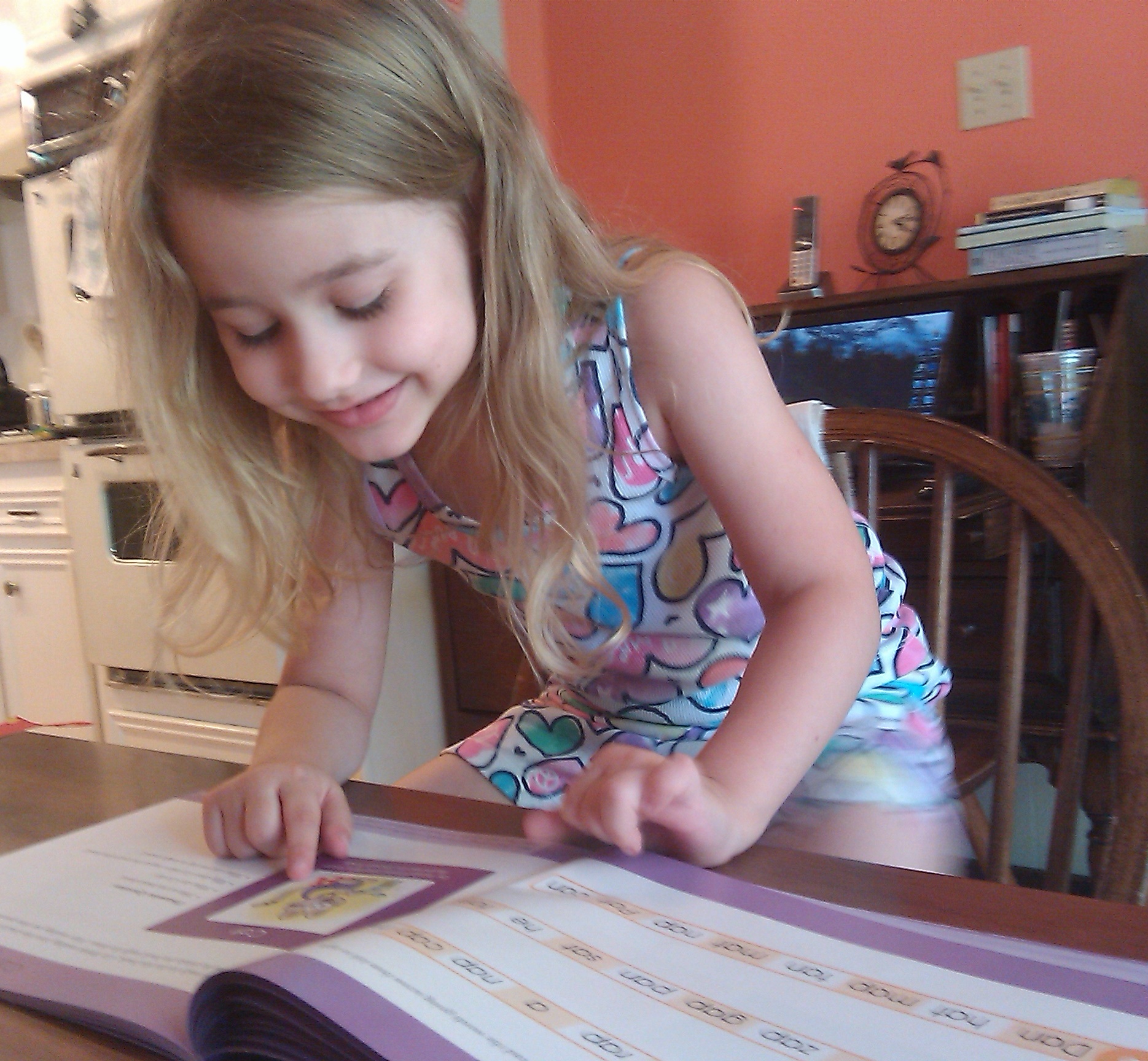
I’ll be starting first grade again today, for the fourth time. I’d thought our homeschooling season would end when Baby Girl the First finished high school, but you know what Mr. Burns said about the best laid plans of mice and men…Baby Girl the Second came along just in time for my fortieth birthday, giving me one more opportunity to begin at the very beginning.

When you read you begin with ABC, or summon the summoners, the twenty-six enchanters.  What a motley set of characters – only a couple of them able to stand alone, but let them start joining up, and there they go, spelling silence into sound.  How do they do that?  How do a bunch of little black marks on a white page bring forth purple mountain majesties and amber waves of grain?  And that’s just the most obvious manifestation of their powers.

They bind:  once you know a rose is a rose you can’t very well imagine it by any other name; and loose:  the rose isn’t just a rose, it’s velvet and fragrance and innocence and my luve is like a red, red rose.  They are the shaping shapes:  sometimes they actually do take on something of the shape of the object they signify – bed, for instance, or hollyhock .  How cool is that?

These twenty-six little bits of code are signs of the Mystery – like the Word that is from the beginning, they lend form to the intangible, showing us glimpses of things beyond our comprehending; runes from the root-tree, searching down to the bedrock of our knowledge; leaves from the tale-tree, spreading, reaching, leaping greenly.  And speaking of re-combining, do they mean the things they name, or do they name the things they mean?

In a strange, fascinating book I read a few years ago (Libyrinth, by Pearl North), I came across an alternate ending that I really like:  “Now I know my ABC’s, all the books are mine to read.”  Yes.  They are the genesis of every utterance, the keys that open the books that open the world.  What a joy it is now to watch Baby Girl the Second testing her power to summon the summoners, and let them sing, and see the magic light up her eyes as she discovers how the summoners will summon Everything.

This post was originally published August 12, 2012 on http://www.allninemuses.wordpress.com.

What Are We Building?

Words said, left unsaid
I don’t know – are we building
a wall, or a bridge?

–Rebekah Choat

I used to think talking to strangers was the hardest thing. What in the world could I say to someone I didn’t know, someone who didn’t know me and probably didn’t want to?

Now that I’m older, and a little less afraid of my own shadow (not to mention everyone else’s) I’ve learned to make easy small talk with people who cross my path: the librarian and the pediatrician’s nurse and the girl who takes my order at Chick-Fil-A. The hardest conversations are with those who are closest to me, who really matter in my life.

Sometimes the words said are the difficult ones. Between any two people with any length of shared history – parents and children, siblings, longtime friends – there are words that live on and on, casting their shadows down the years even after the speaker or the hearer or both are gone, for better or worse. “You’re just not cut out for that; why don’t you give it up?” can change the course of an individual life, a career, a family’s dynamic. So can, “You really have a way with words (or children, or paint and canvas).” Even harder can be the words that need to be said, that have to be said, awkward and painful and necessary words: “I’m sorry.” “You were right.” “I’m worried about you.” One of the most nerve-wracking, heart-wrenching conversations I’ve ever felt compelled to initiate was with a dear friend who I feared was unwittingly making a misstep that could have adversely affected his credibility, his reputation, his future.

The words left unsaid can cut both ways as well. There’s a particular void in a child’s heart that can only ever be filled by “I’m proud of you,” a certain level of trust that can never quite be reached without “I will always love you, no matter what.” But how fortunate is the teenage girl who’s never heard “You’d be so pretty if you’d just lose ten pounds (or wear different clothes, or do something with your hair).” How blessed is he who can refrain from saying “I told you so.”

Words, like lengths of lumber or blocks of stone, are raw material. They have a certain innate strength and form, but it is the builder who invests them with structure and purpose. They can be arranged in virtually limitless configurations, made the means to reach any end. Words, identical words, can be barriers that separate us or spans that bring us together, depending on intent and interpretation. Silence, too, can be used either way.

A confidence shared. An explanation given. A candid reaction. A confession made. An apology offered and accepted – or refused. A bit of information withheld. A secret kept. An unstated opinion. An affirmation or a condemnation left unspoken.

Any one of these may be a brick laid into the walls that stand between us. Any one of these may be a stepping stone laid into the paths that lead to where our ways meet.

What Do You Mean?

13006_483494761699740_227830721_n

I had an argument a little while back with my then-five-year-old daughter.  We were in a department store, waiting while her older sister tried on clothes.  Baby Girl the Second had carried a blanket in with her, and was passing the time playing dress-up herself, draping it this way and that, posing, asking, “Don’t I look divine?”  The gentleman waiting for his wife shot a bemused glance our way when I answered, “No, divine is what God is.  You’re pretty.”  This went on for several minutes, with BGS declaring ever more emphatically, “Well, divine means pretty to me.”

I got the feeling that the waiting gentleman thought I was being rather legalistic with a small child on a matter that wasn’t really important.  And I have a pretty good idea which of BGS’ books planted the mis-definition in her head – a cute series about a little girl who loves big, fancy words and defines them parenthetically, but now that I think of it, not always very accurately, for her audience.

What’s the big deal?  No kingdoms are going to rise and fall on the misuse of a word by a five-year-old girl in greater suburbia.  I understand that.  And despite my upbringing, I don’t actually believe we’re likely to be struck by lightning due to an accidental misappropriation of an attribute of the Almighty.  But the erosion of language is a big deal.

Words matter.  Words contain and convey power, and words have precise meanings, and the gradual alteration of the meanings dilutes or redirects the power.  As the process goes on, the current usage of a word may be so far removed from its original intent as to render it virtually meaningless.  Gentleman, for instance.  It once described a very specific status, that of being well-educated, well-bred, and well-to-do.  The world has changed, and perhaps it’s of little consequence that gentleman now indicates simply a nice, well-mannered, preferably well-groomed, person of the male gender.  And how about nice, while we’re here?  It used to mean fastidious, exacting of great precision.  Maybe it’s not earth-shaking that today, as C.S. Lewis points out in the preface to Mere Christianity, “it no longer tells you facts about the object:  it only tells you about the speaker’s attitude to that object.  (A ‘nice’ meal only means a meal the speaker likes.)”

The subtle shift of the meanings of other words, however, can have far-reaching effects.  Think about toleranceEqualityChristian.  What happens when freedom means one thing to you, and a different thing to me?

This piece was first published as “The Power of Words, Part Three” on http://www.booksbybecka.com on October 16, 2012.

Words as Weapons

It’s pretty obvious that words spoken to – or shouted at – or whispered about – us can inflict harm.  Words can be wielded as weapons in a number of ways.  But casualties are not always the result of direct frontal assault, covert sniper fire, or even espionage.  Sometimes we are laid waste by siege.  What is withheld weakens us to the breaking point.

Some of the people who hurt us the most, and the deepest, can honestly claim never to have said a negative word to or against us.  But they haven’t said anything positive either, and the words never said can leave a gaping void.  It’s good of them, maybe, not to mention our mistakes.  It’s cold of them not to acknowledge our successes.  Refraining from tearing down is not the same as building up.

This piece was first published as “The Power of Words, Part Two” on http://www.booksbybecka.com on October 9, 2012.

Sticks and Stones

2013-02-18 15.30.45

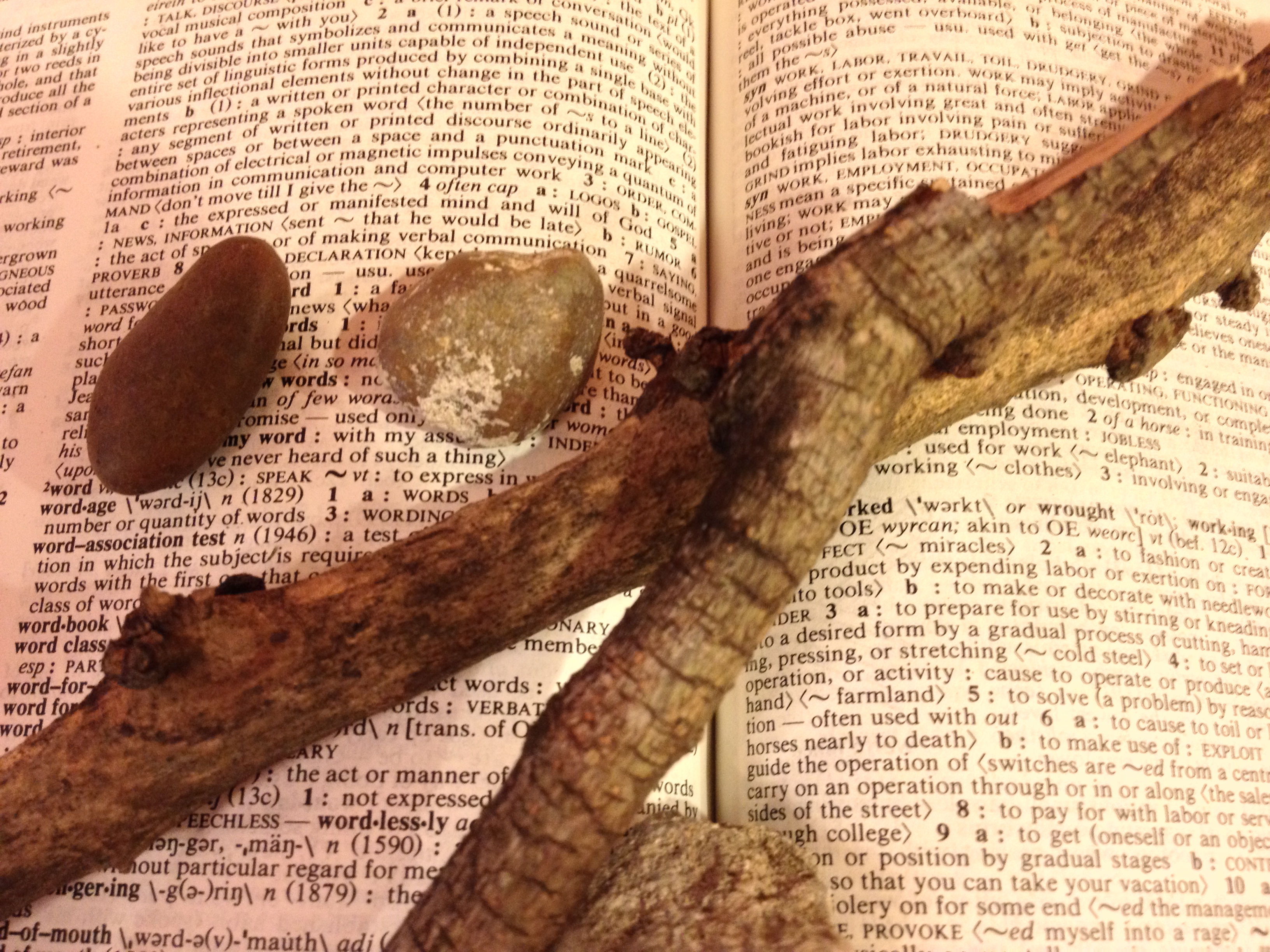
I believe strongly in the power of words.  I’m sure whoever – I always imagine it was a frazzled mother trying to comfort a distraught child – first spoke that ditty about sticks and stones meant well, maybe even believed it herself, but she was sadly mistaken.  Words can inflict deep wounds that take much longer to heal than broken bones do, perhaps precisely because the word-wounds are so deeply hidden and therefore not recognized and treated.  We’re taught to brush away insults, to shrug off epithets.  I think something in that shrugging motion actually causes the barbs to work further in under our skin, where their poison seeps into our bloodstream.  But we don’t mention our discomfort, won’t let ourselves succumb to the “weakness” of admitting our disease.

Sometimes we can pull it off.  We’re strong enough to absorb small stings with minimal lasting damage.  Some of us, sometimes, are so tough that we walk around with embedded shrapnel, trying not to limp and pretending that we aren’t in pain.  But some of us have been pierced with words like Morgul-blades:  the skin has closed over the wound quickly, leaving only a small white mark; but the scar conceals a deadly splinter, festering, working its way inwards.  If that malicious fragment is not found and excised, it will destroy us.

We are rarely, if ever, able to perform the operation ourselves.  We are too bewildered to recognize what needs to be done, too lost in pain to be able to focus our attention on the precise source of the infection, too weak and fearful to begin the excruciating process.  This is one of the many reasons it is vital for us to live in community, to surround ourselves with trusted friends who can often see our wounds more clearly and objectively than we can; who will encourage us, even carry us if necessary, to seek help and healing; who will sit with us and hold our hands through the dark, painful hours, speaking words of light and life.

This piece was first published as “The Power of Words” on http://www.booksbybecka.com on October 4, 2012.