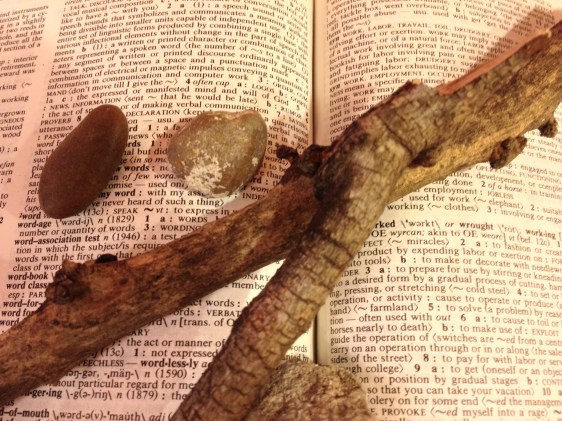
I believe strongly in the power of words. I’m sure whoever – I always imagine it was a frazzled mother trying to comfort a distraught child – first spoke that ditty about sticks and stones meant well, maybe even believed it herself, but she was sadly mistaken. Words can inflict deep wounds that take much longer to heal than broken bones do, perhaps precisely because the word-wounds are so deeply hidden and therefore not recognized and treated. We’re taught to brush away insults, to shrug off epithets. I think something in that shrugging motion actually causes the barbs to work further in under our skin, where their poison seeps into our bloodstream. But we don’t mention our discomfort, won’t let ourselves succumb to the “weakness” of admitting our disease.
Sometimes we can pull it off. We’re strong enough to absorb small stings with minimal lasting damage. Some of us, sometimes, are so tough that we walk around with embedded shrapnel, trying not to limp and pretending that we aren’t in pain. But some of us have been pierced with words like Morgul-blades: the skin has closed over the wound quickly, leaving only a small white mark; but the scar conceals a deadly splinter, festering, working its way inwards. If that malicious fragment is not found and excised, it will destroy us.
We are rarely, if ever, able to perform the operation ourselves. We are too bewildered to recognize what needs to be done, too lost in pain to be able to focus our attention on the precise source of the infection, too weak and fearful to begin the excruciating process. This is one of the many reasons it is vital for us to live in community, to surround ourselves with trusted friends who can often see our wounds more clearly and objectively than we can; who will encourage us, even carry us if necessary, to seek help and healing; who will sit with us and hold our hands through the dark, painful hours, speaking words of light and life.
This piece was first published as “The Power of Words” on http://www.booksbybecka.com on October 4, 2012.
 Becka's Blog